I work in observational cosmology. Most of my projects ask how a measurement limit, such as photometric-redshift error or a survey window, changes what a galaxy survey can measure. I build the simulations, pipelines and statistics needed to answer that.
BAO reconstruction in the presence of photometric-redshift uncertainty
Feb 2026–presentArizona Cosmology Lab, Steward Observatory, University of ArizonaAdvisor: Prof. Tim Eifler
Reconstruction sharpens the baryon acoustic oscillation (BAO) feature by undoing part of the galaxy motion that blurs it. Photometric redshifts smear galaxy positions along the line of sight. I test when standard reconstruction still improves BAO distances for samples with SPHEREx-like redshift errors and number densities.
I developed photorecon, a Python package for transverse BAO reconstruction on photometric galaxy samples that follows the pyrecon interface. It is now being tested for SPHEREx at low redshift. I found a systematic bias in the MCMC pipeline and cut it sixfold by cross-validating two covariance estimators over a 250-cell grid.
Across 25 DESI AbacusSummit mocks, combining four redshift-precision classes per bin raised the 2D BAO figure of merit by 26 to 271 percent after reconstruction and recovered the input distances within 1.3σ. I identified the operating range of standard reconstruction, a redshift error σ/(1 + z) below about 0.003 and shot noise below about 2.5 times the BAO-scale clustering power, to guide SPHEREx sample selection. A first-author paper is in preparation.
Hallmark: data management for simulation libraries
Aug 2026–presentTIMESTEP Program, Steward Observatory, University of ArizonaAdvisor: Dr. Chi-kwan Chan
Event Horizon Telescope simulation libraries hold large numbers of files whose parameters live in their paths. Hallmark is an open-source Python package that decodes those paths into structured parameters and data frames, so a library can be searched and reused. I work on the metadata extraction, Git-based data versioning, and parameter-driven downloads of public-data subsets such as DESI.
Jun–Aug 2024SPHEREx Team, Summer Undergraduate Research Fellowship (SURF), CaltechAdvisor: Dr. Olivier Doré
A survey window mixes Fourier modes in the measured galaxy power spectrum. The effect is largest on the scales that carry the signal of local primordial non-Gaussianity. I built a ResUNet in PyTorch that predicts window-function effects quickly, and it reached sub-percent prediction error on validation data.
I owned the full pipeline: lognormal mock catalogs with realistic SPHEREx survey masks, distributed training on Linux HPC, and validation against analytic baselines.
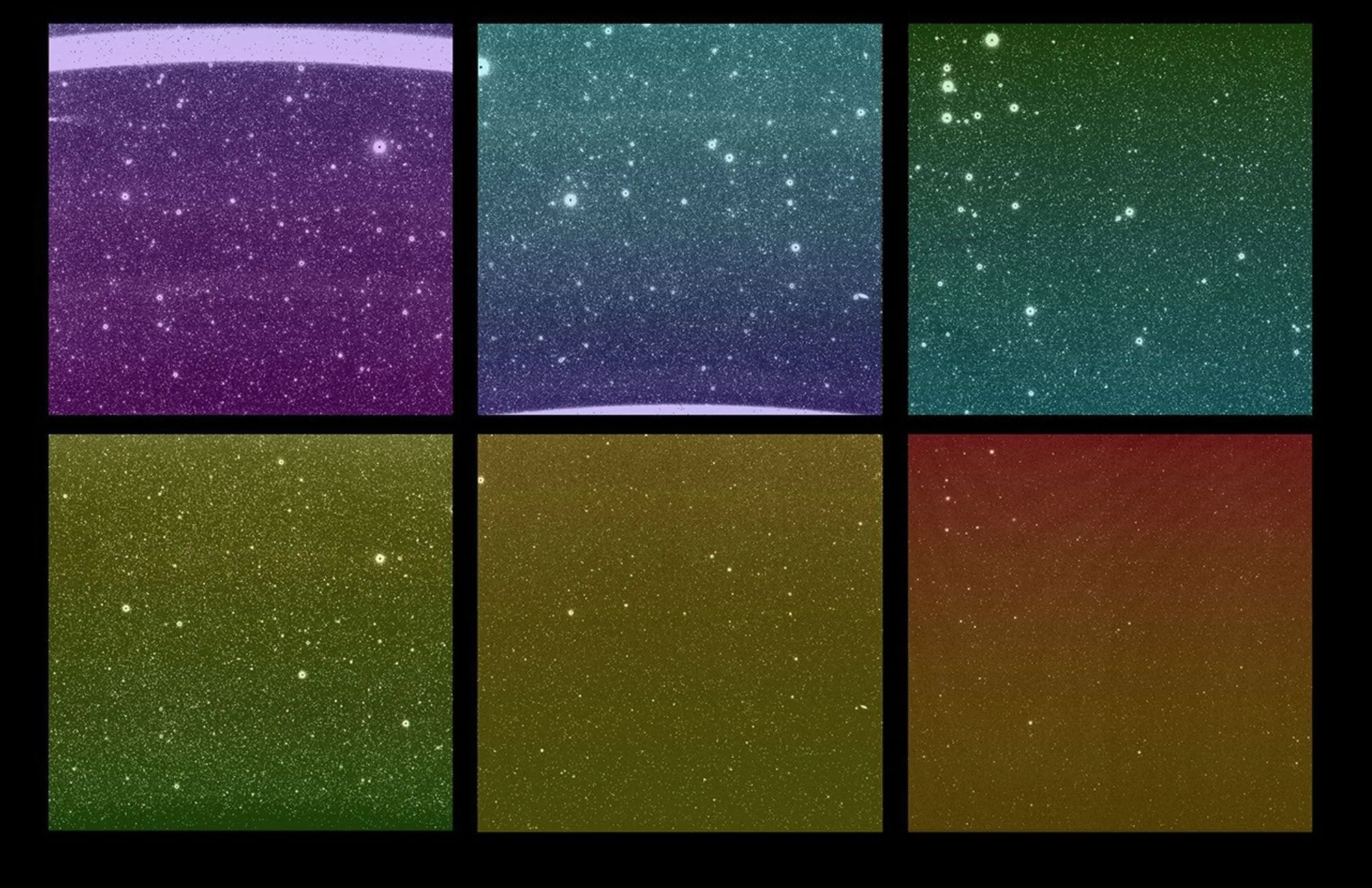
A SPHEREx first-light exposure. Image: NASA/JPL-Caltech.
Roman and Rubin weak-lensing synergies
May 2022–Dec 2024Cosmology Group, Department of Physics, Duke UniversityAdvisor: Prof. Michael A. Troxel
Roman observes from space and Rubin from the ground. The project tested how a joint analysis can improve photometric-redshift calibration and cosmological constraints. I built a Python pipeline for joint analysis of 120 TB of Roman and Rubin simulations, with two-point correlation functions and MCMC inference of cosmological parameters.
New mode-based calibration strategies raised the Figure of Merit by 20 percent. I contributed simulation and analysis work to OpenUniverse2024.
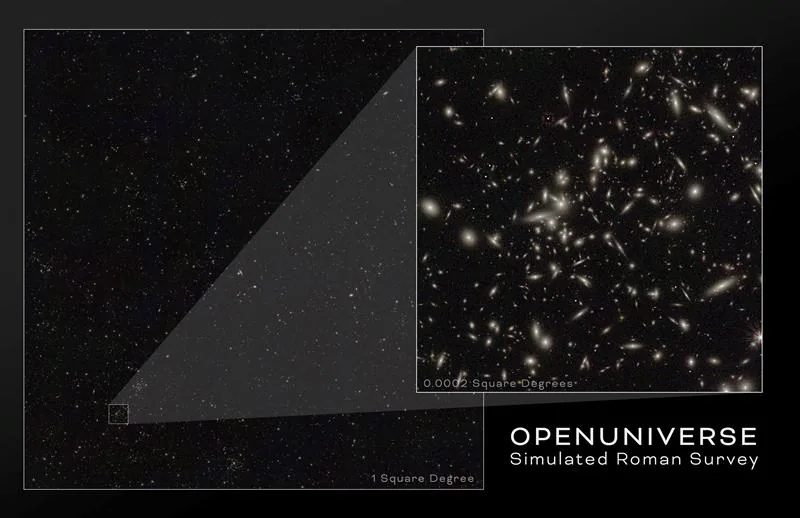
A simulated Roman field from OpenUniverse2024. Image: NASA Goddard and M. Troxel.
Calibrating the distance ladder with synthetic stars
Sep 2023–Aug 2024Cosmology Group, Department of Physics, Duke UniversityAdvisor: Prof. Daniel Scolnic
The goal was a common framework for comparing distance-calibration methods across teams, and a test of the JWST and HST distances behind the local Hubble constant. I built a Python pipeline for synthetic stellar catalogs and for extracting features from Hertzsprung-Russell diagrams. I also compared JWST distance measurements across the literature and measured galaxy-dust correlations in SDSS data. This work contributed to Riess et al. (2024).
Wu, T., Paillas, E., & Eifler, T. “BAO Reconstruction in the Presence of Photometric Redshift Uncertainty.”Manuscript in preparation.
OpenUniverse et al. (including T. Wu). “OpenUniverse2024: A Shared, Simulated View of the Sky for the Next Generation of Cosmological Surveys.” MNRAS 544(4), 3799–3823 (2025). doi:10.1093/mnras/staf1833. JournalarXivSummary
Riess, A. G., Scolnic, D., et al. (including T. Wu). “JWST Validates HST Distance Measurements: Selection of Supernova Subsample Explains Differences in JWST Estimates of Local H₀.” ApJ 977, 120 (2024). arXiv:2408.11770. JournalarXivSummary
Talks
Oct 2026
BAO Reconstruction with Photometric Redshift Smearing
BAO Reconstruction with Photometric Redshift Smearing
Steward Astronomy Symposium, University of Arizona
Oct 2026
BAO Measurements, Cosmology Session
SPHEREx Science Team Meeting
Jun 2026
BAO Measurements, Cosmology Session
SPHEREx Science Team Meeting (Face-to-Face E4), IPAC, Caltech
Apr 2026
BAO analysis segment of the SPHEREx team colloquium
SO and NSF NOIRLab Joint Colloquium, Steward Observatory
Aug 2024
Predicting Power Spectrum Window Function with Neural Networks
SURF Final Presentation, SPHEREx Team, Caltech
Aug 2023
Quantifying Wetland Carbon Emissions in the Southeastern United States
Data+ Final Presentation, Duke University
Software
cosmockCo-developer
Tomographic weak-lensing convergence maps from input maps and angular power spectra, using point-transformed Gaussian fields. github.com/ivan96eb/cosmock
hallmarkContributor
Reproducible data management for simulation libraries, motivated by Event Horizon Telescope calibration and simulation workflows. github.com/lanisrc/hallmark
Teaching and outreach
2022–2024
Assistant, Department of Mathematics, Duke University
Help Room shifts and SAGE discussion sections for multivariable calculus, linear algebra and probability.
2025
Physics and mathematics tutor, PalmDrive Academy
AP Physics, AP Calculus and Cambridge A-Level Physics.
2026–present
Peer mentor for incoming students, University of Arizona
Mentoring first-year students through the move to university study.
2021–2024
Founder and President, Stargazing Devils
Founded Duke’s first astronomy club. Ran weekly observatory open houses and secured funding for 14 students to attend the 2023 and 2024 solar eclipses.
2022–2024
President and Co-President, Society of Physics Students, Duke
Rebuilt the chapter with research panels, student and faculty seminars, and a mentorship program for women in physics.
2022–2024
Student Ambassador, American Physical Society
Organized study sessions and manuscript workshops, and advocated for physics-community priorities on Congressional Visits Day.
Awards
2026Global Wildcat Scholarship, University of Arizona
2024Faculty Scholars Finalist, Duke University
2024Jocelyn Bell Burnell Outstanding Leadership Scholarship, Society of Physics Students
2024Inductee, Sigma Pi Sigma
2021Third Grand Award in Physics and Astronomy, Regeneron ISEF
2021Top Gold Medalist, British Physics Olympiad
Education
2026–2027
B.S. in Physics, minor in Mathematics (expected by May 2027)
University of Arizona. Advisors: Prof. Tim Eifler, Arizona Cosmology Lab, and Prof. Chi-kwan Chan, EHT Collaboration.
2021–2024
Physics and Mathematics
Duke University. Advisors: Prof. Michael A. Troxel and Prof. Daniel Scolnic.